

- Home
- About carillons
- What is the history of the carillon?
What is the history of the carillon?
The carillon was not invented, but rather it evolved over several centuries. In the Middle Ages, the ringing of a bell was used for communication—to announce a call to prayer, to alert of fire, or to signal the time of day. What began as sounding one or more bells grew into elaborate tower clocks that played full melodies every hour. By the 16th century, people connected keyboards to the bells so that they could play the melodies, rather than machines.
This development happened in the Low Countries—what is now Belgium, the Netherlands, and northern France. Building a carillon signaled wealth and prestige to neighboring cities. In 1644, the musician Jacob van Eyck and the bellfounding brothers Peter and François Hemony perfected the art of tuning bells. Their especially beautiful sounding carillons were in high demand, and musicians began to see the potential in the carillon as a full-fledged musical instrument.
Many Hemony-made carillons are still ringing, such as this one in Rotterdam, Netherlands
(video of Richard de Waardt playing from the De Gruytters carillon book, a manuscript from the 18th century)
From the time of the Hemony brothers to the late 18th century, "carillon culture" experienced its heyday. Cities, churches, and abbeys spent large sums of money to provide the public with free music on their carillons. The instruments were ubiquitous musical backdrops to city life. Carillonists explored the possibilities of their instruments, playing folk tunes, arrangements of popular music, and even original compositions.
In the 19th century, however, things changed. The French Revolution turned the Low Countries away from carillons. Some were destroyed, others were played less often. Furthermore, the carillon failed to cater to changing musical tastes and styles. Bellfounders made fewer instruments of lesser quality than before. Carillon culture declined, but it did not disappear. Nationalistic movements within modern-day Belgium used the carillon as a symbol of their cause, and public interest soon increased.
Carillons such as the Dom Tower of Utrecht, Netherlands, are the musical backdrop of city life in the Low Countries
(video of Joey Brink playing Che si può fare)
In Mechelen, Belgium, the city carillonist Jef Denyn revived public interest in the carillon. His virtuosic Monday night concerts, beginning in 1892, attracted trainloads of listeners. He demonstrated the carillon's value as a concert instrument, not just a source of background music. At the outbreak of World War I, Germany invaded. Sadly, many of Belgium's carillons were stolen, silenced, or destroyed—acts that its allies decried. They romanticized a day when the Belgian people could celebrate their liberation with peals of bells. To memorialize the casualties of the war, communities across the world erected war memorial and peace carillons.
Meanwhile in North America, William Gorham Rice, a civil servant from New York, was falling in love with the carillon. He wrote 3 books and gave several lectures to argue the societal value of carillons, and it was well-received. Carillons were installed all around the United States and Canada. In 1922, with the support of donors including John D. Rockefeller Jr. and future US president Herbert Hoover, Rice helped establish the world's first carillon school: the Royal Carillon School "Jef Denyn" in Mechelen. Many early North American carillonists were educated there.
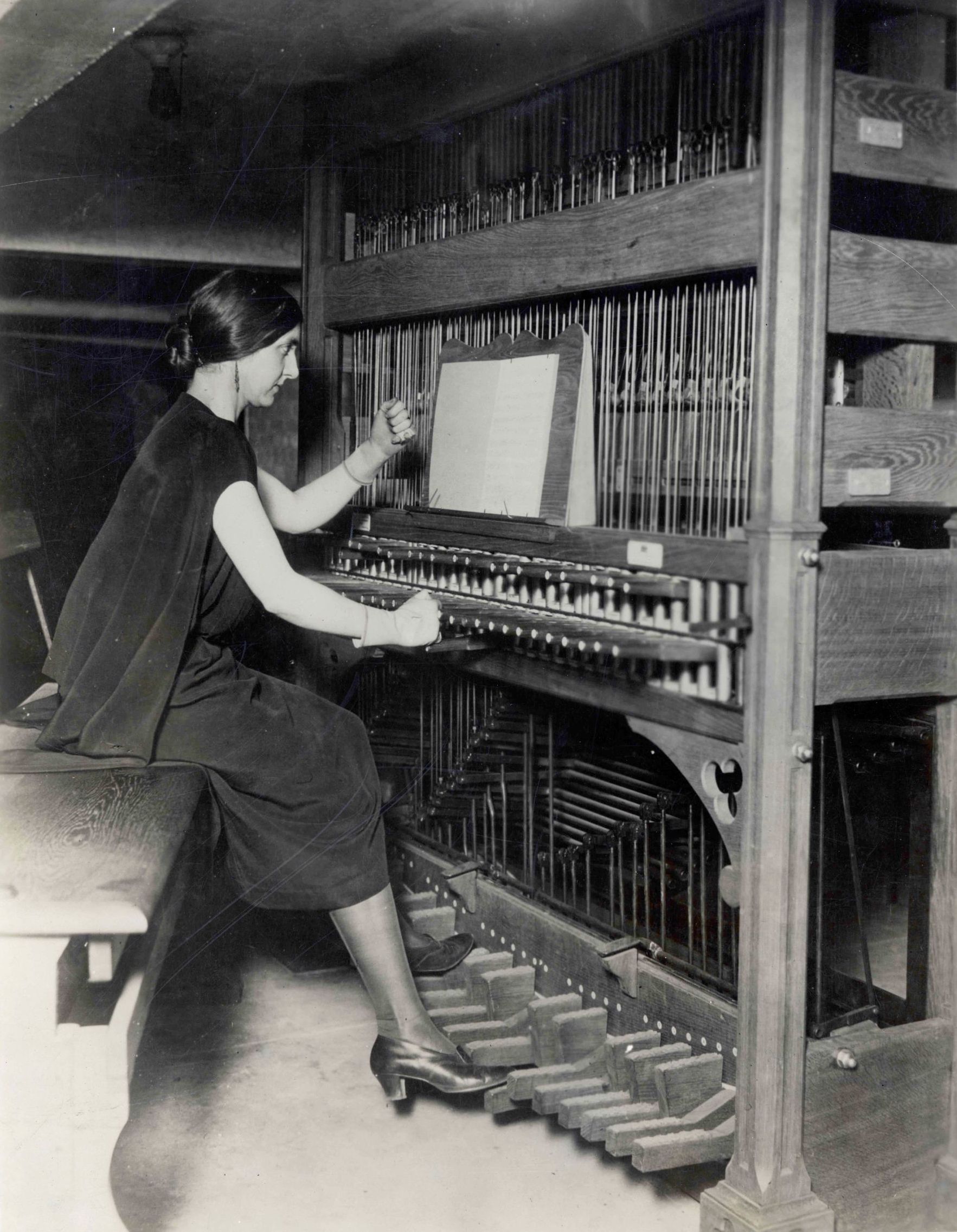
Women such as Ruth Muzzy Conniston (above) saw professional success in the early North American carillon culture (Credit: Anton Brees Carillon Library)
Thanks to Rice's publicity campaign, the profession of the carillonist developed quickly on the continent. In 1922, Mary Mesquita Dahlmer was first North American appointed to play the carillon. Her post was in Gloucester, Massachusetts. Percival Price was the first Canadian appointee soon after. He played in Toronto, Ontario.
After the founding of The Guild of Carillonneurs in North America in 1936, North Americans sought to create a carillon culture distinct from its European counterpart. Over the decades, wealthy donors continued to flood the continent's churches and universities with massive carillons. Composers experimented with new styles of music, all the while showcasing the carillon's power as a musical instrument.
Today, there are over 700 carillons and counting in more than 30 countries. Nearly 200 of them are found throughout North America. Carillonists across the world find themselves more connected than ever before. People hear concerts online and in hundreds of cities every day.
Contact us | Privacy Policy
Copyright © . All rights reserved.